Living a mile from the ocean sounds great until you open your electrical panel and find a white crust where copper used to be. Oceanside homeowners deal with that specific problem more often than almost anywhere else in San Diego County, and the fix costs more than most people expect. Here’s what you actually need to know before you call a local electrician.
What homeowners in Oceanside actually pay for common jobs
Oceanside rates track closely with the rest of San Diego County, with one notable exception: anything exposed to salt air carries a materials premium. Here’s a realistic breakdown.
Standard service call: Most licensed electricians in the area charge $85–$150 to show up and diagnose the problem. That fee typically rolls into the total if you move forward with the work.
Panel swap (200-amp): Expect $2,200–$3,800 installed, including permit. Coastal homes often land at the top of that range because stainless hardware and corrosion-resistant enclosures add $200–$400 to materials alone. Our panel upgrade cost guide for 2026 breaks down the line items in detail.
GFCI outlets: $150–$250 per outlet, including labor. Oceanside code requires GFCI protection within 6 feet of any water source — bathrooms, kitchens, garages, and exterior locations. Older homes in South O often need four to six of these replaced at once.
Outlet additions: $200–$350 per outlet for a standard 120V receptacle. See our full cost-to-add-an-outlet guide if you’re planning a garage or patio project.
EV charger installation: $600–$1,800 for a Level 2 charger, depending on panel capacity and run length. Rancho Del Oro households adding a second EV are regularly hitting the upper end because their original 150-amp panels are already loaded.
Ceiling fans, switches, dimmers: $125–$300 per fixture, labor only. Simple swaps are on the low end; runs through attics or concrete walls push it higher.
For a broader comparison across the county, our San Diego electrician cost guide gives context on what drives prices up or down.
Salt-air corrosion on panels, conduit, and exterior fixtures
The ocean is roughly 1.5 miles from the 76/5 interchange. That’s close enough that salt-laden marine layer settles on every exposed metal surface in the city, often overnight. The damage is slow, invisible until it isn’t, and expensive to ignore.
What corrodes first
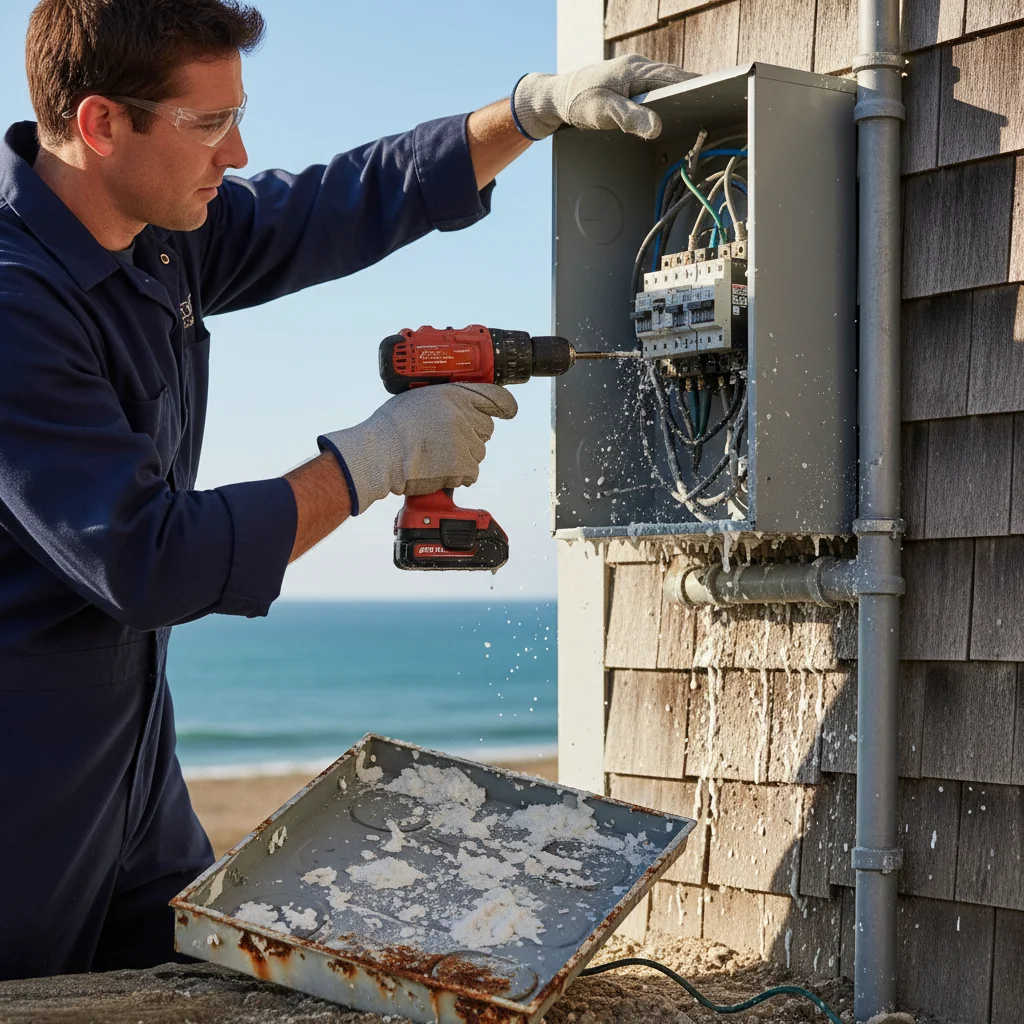
Exterior panel enclosures are the most common casualty. The factory paint on a standard gray steel panel box lasts 5–10 years in coastal conditions before rust bubbles start forming at the seams. Once moisture gets under the cover, it finds the bus bars, the neutral lug, and eventually the main breaker terminals. Pitted bus bars create resistance, resistance creates heat, heat causes fires.
Conduit fittings are a close second. Standard steel set-screw connectors corrode at the threads, loosen, and let moisture into the conduit run. THWN wire inside wet conduit fails years ahead of schedule.
Exterior light fixtures, outlet covers, and junction box screws follow the same pattern. Aluminum and stainless fittings hold up far better than standard zinc or mild steel — and in Oceanside, the upgrade is worth it every time.
How to spot it early
Open your exterior panel cover once a year. Look for white or orange powder around lugs, terminals, and bus bars. A clean panel is silver-gray. A corroding panel looks dusty and discolored. If you see either, call before it progresses.
Also check exterior conduit runs. If the gray conduit near your meter base has bubbling paint or rust streaks running down the wall, the fittings are likely compromised.
Permits at the Oceanside building department
Oceanside issues electrical permits through the Development Services Department at City Hall, 300 N Coast Hwy. Most straightforward jobs — panel upgrades, service changes, subpanel installs — can be permitted over the counter or online through the city’s permit portal. Turnaround on simple electrical permits is typically same-day to two business days.
A few things Oceanside inspectors pay close attention to:
Service entrance clearances. Oceanside follows the California Electrical Code (which adopts NFPA 70 with amendments). Inspectors flag panel locations that don’t maintain proper working clearance — 30 inches wide, 36 inches deep, 6.5 feet of headroom in front of the panel.
Exterior work. Any exterior panel, conduit, or outlet replacement in a coastal environment gets a closer look. Using weather-resistant (WR) outlets and in-use covers is mandatory; inspectors will note substandard materials.
GFCI and AFCI. Older Oceanside homes getting panel upgrades must bring new circuits up to current code, which means AFCI breakers on bedroom and living area circuits and GFCI protection at required locations.
Always verify your electrician pulls the permit. If they suggest skipping it to save money, that’s your signal to call someone else. You can verify any contractor’s license at the CSLB license check before signing anything.
South O, Fire Mountain, and Rancho Del Oro: typical wiring by area
Oceanside’s neighborhoods aren’t uniform. The housing stock varies significantly by decade, and that changes what electrical problems you’re likely to encounter.
South Oceanside
South O is one of the oldest parts of the city. Many homes were built in the 1950s and 1960s, and some still have the original 100-amp service with outdated wiring configurations. We see aluminum branch circuit wiring in this area more than anywhere else in Oceanside — a known fire hazard that requires either replacement or COPALUM remediation. If you’re buying or renovating in South O, a pre-purchase electrical inspection is money well spent. Our guide to aluminum and knob-and-tube wiring explains what to look for.
Fire Mountain
Fire Mountain homes are mostly 1970s–1990s construction. The panels here are typically 150-amp Federal Pacific or Zinsco units — both of which have documented breaker failure problems. If your Fire Mountain home still has one of these panels, it’s not a matter of whether to replace it, it’s when. Read our Federal Pacific and Zinsco panel guide for specifics.
Rancho Del Oro
Rancho Del Oro is newer — mostly 1990s–2000s construction — with 150- or 200-amp service already in place. The main issue here is capacity. These homes were built before EV chargers, heat pump water heaters, and solar inverters became standard additions. A family adding a Level 2 charger and an HVAC upgrade to an already-loaded 150-amp panel often needs a panel upgrade before any of that new equipment can run safely.
Response times for same-day vs. scheduled service
Oceanside is about 35–40 minutes from central San Diego in normal traffic, closer to 50–60 during the afternoon commute on I-5. That distance matters when you’re dealing with a tripped main breaker or a dead circuit.
Same-day service is available for most non-emergency jobs if you call before noon. Afternoons book faster — especially Friday — so earlier calls get better windows.
Emergency response — meaning active sparking, a burning smell, or a complete loss of power — is a different category. For true electrical emergencies, the goal is arrival within two hours. If you’re dealing with a burning smell and don’t know the source, don’t wait for a scheduled appointment. Our emergency electrician guide outlines what counts as an emergency versus what can wait until morning.
Scheduled work (panel upgrades, rewires, EV charger installs) typically gets booked two to seven days out, depending on the week. Projects requiring a permit inspection may add one to three days if the inspector’s schedule is backed up.
When to upgrade an exterior panel before it fails
The panel on your Oceanside home is doing more work than it was designed for and taking more environmental abuse than panels in inland cities. That combination shortens its effective lifespan.
You should start planning a panel upgrade — not just thinking about it — when you notice any of these signs:
- The panel cover shows surface rust, and the home is within two miles of the coast
- Breakers trip more than once a month under normal loads
- You’re adding a second circuit to a panel already at 80% capacity
- The panel is a Federal Pacific, Zinsco, or any 60-amp fused box
- An electrician opens the panel and finds discoloration, pitting, or loose lugs
A proactive upgrade on your schedule costs $2,200–$3,800. An emergency replacement after a fault — with expedited permit processing, potential damage remediation, and the stress of no power — runs significantly more. Our 200-amp panel guide walks through what the upgrade actually involves so you know what to expect.
SDG&E sometimes offers programs tied to panel upgrades that support EV readiness and electrification. Check SDG&E’s current programs before scheduling your upgrade — it’s worth a five-minute look.
When to call us
If your Oceanside home has a corroded panel, aluminum branch circuit wiring, or a breaker that keeps tripping, those aren’t watch-and-wait situations — they’re licensed-electrician jobs. Same goes for any panel upgrade, new service entrance, or exterior work that requires a city permit. Call us at (858) 925-5546 for a same-day estimate.